EOAT in Production Automation: Functions, Applications, and Limitations
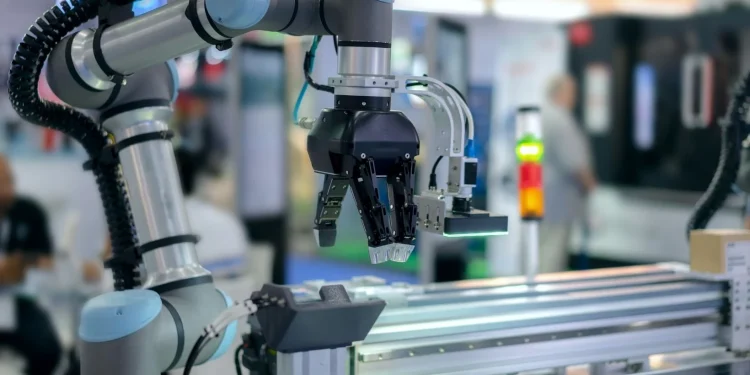
The effectiveness of industrial automation depends not only on the robot itself, but critically on the tools mounted at the end of its arm. End-of-arm tooling (EOAT) determines what a robot can actually do in a production environment-whether it assembles components, feeds machines, performs quality inspections, or handles delicate materials. For production and maintenance managers evaluating automation investments, understanding EOAT capabilities and constraints is essential to making realistic decisions about what processes can be automated and how well they will perform.
The Role of EOAT in Modern Manufacturing Processes
EOAT encompasses all devices attached to a robot’s mounting flange to interact with the production environment. These tools transform a general-purpose manipulator into a specialized production asset. The range includes grippers of various actuation principles, vacuum systems, tool changers, force-torque sensors, vision systems, and specialized application tooling for tasks like welding, dispensing, or deburring.
The functional match between EOAT and process requirements determines whether automation succeeds or fails. A gripper designed for handling cardboard boxes cannot reliably manipulate precision-machined metal parts. A vacuum cup suitable for flat glass panels will fail when attempting to lift porous or curved components. This specificity means that EOAT selection requires detailed analysis of workpiece geometry, material properties, handling forces, cycle time requirements, and environmental conditions.
In assembly operations, EOAT must frequently manage multiple part types with varying geometries. Multi-finger grippers with compliant elements can adapt to dimensional variations, while quick-change systems allow a single robot to switch between tools for different process steps. In machine tending, grippers must withstand thermal cycling, resist coolant contamination, and maintain grip reliability across thousands of cycles per shift. Material removal applications demand EOAT that can maintain consistent force and orientation while compensating for tool wear.
Application Domains and Process-Specific Requirements
Assembly processes place distinct demands on EOAT compared to material handling or machining support. In electronics assembly, grippers must apply controlled insertion forces measured in newtons while maintaining positional accuracy within hundredths of a millimeter. Component orientation must be verified before insertion, often requiring integrated vision or force feedback. The EOAT must not generate particles or electrostatic discharge that could damage sensitive components.
Machine tending applications typically involve higher payloads and more demanding environments. EOAT for CNC machine loading must reach into confined spaces, maintain grip security despite vibration and thermal variations, and resist degradation from cutting fluids and chips. Cycle time pressures often require parallel gripper motion during robot travel, placing additional dynamic loads on the tooling. Part locating features must compensate for fixture variations without requiring complex programming.
Quality inspection increasingly incorporates EOAT-mounted vision systems and measurement devices. A collaborative robot equipped with a structured light scanner can perform dimensional verification directly in the production flow, eliminating separate inspection stations. Force-torque sensors integrated into EOAT enable automated testing of assembly integrity-verifying snap-fit engagement, threaded joint tightness, or bearing installation quality through force signature analysis.
Material processing applications such as sanding, deburring, or polishing require EOAT with compliant force control. Passive compliance devices allow the tool to follow surface contours while maintaining consistent contact pressure. Active force control systems adjust robot motion in real-time based on sensor feedback, enabling consistent material removal across workpieces with geometric variation. These capabilities allow collaborative robots to perform finishing operations traditionally requiring skilled manual labor.
Performance Boundaries and Technical Constraints
EOAT imposes fundamental limitations on what automation can achieve in a given process. Payload capacity constrains the maximum part mass that can be handled, but the effective payload decreases significantly when accounting for EOAT mass, gripping force requirements, and acceleration loads during motion. A robot with a nominal 10 kg payload rating might reliably handle only 5-6 kg parts when equipped with a pneumatic gripper and operating at production speeds.
Gripping force and contact area determine handling reliability. Insufficient grip force causes part slippage during acceleration or orientation changes. Excessive force damages delicate components or deforms thin-walled parts. The coefficient of friction between gripper surfaces and workpiece material varies with surface finish, contamination, and temperature, requiring safety margins in force calculations that further reduce effective payload.
Precision limitations arise from both EOAT design and robot kinematics. Gripper jaw parallelism, repeatability of jaw position, and deflection under load all contribute to final positioning uncertainty. For high-precision assembly, these errors may exceed process tolerances even when the robot’s nominal repeatability appears adequate. Compensation through force-guided insertion or vision-based correction adds cost and complexity.
Cycle time constraints often emerge from EOAT actuation speed rather than robot motion capability. Pneumatic grippers require time for pressure buildup and controlled release. Vacuum systems need time to establish and break suction reliably. Electric grippers offer faster actuation and better controllability but add weight and require power transmission to the robot end effector. Process-specific EOAT like welding guns or dispensing valves impose their own timing requirements that cannot be compressed without affecting quality.
Collaborative Robots and EOAT Integration Challenges
Collaborative robots operate with inherent safety limitations that affect EOAT selection and performance. Force and speed limitations designed to prevent injury during human contact also constrain process capability. A collaborative robot typically operates at lower speeds and with reduced payload compared to industrial robots in fenced cells, directly impacting cycle time.
EOAT for collaborative applications must consider safety implications of tool geometry, actuation force, and surface characteristics. Sharp edges, pinch points, and high-force grippers may require additional guarding or force limiting, potentially negating the advantages of collaborative operation. Some EOAT designs incorporate soft or compliant surfaces specifically for collaborative environments, though these may reduce precision or grip reliability.
The flexibility advantage of collaborative robots-easy redeployment and reconfiguration-depends heavily on EOAT versatility. Quick-change tool systems allow a single robot to serve multiple processes, but each tool still requires application-specific design, testing, and programming. The economic case for collaborative automation weakens when process requirements demand highly specialized EOAT with limited reuse potential across the facility.
Integration with robot control systems presents practical challenges. Modern EOAT increasingly incorporates sensors, actuators, and communication interfaces. Ensuring reliable data exchange between EOAT and robot controller, particularly for force control or vision-guided applications, requires compatible communication protocols and sufficient I/O capacity. Legacy robots may lack the connectivity needed for advanced EOAT functions, limiting upgrade paths.
Testing, Validation, and Deployment Realities
Application testing prior to full deployment is essential but often underestimated in scope and duration. EOAT performance depends on subtle interactions between gripper design, workpiece characteristics, and process conditions that may not be apparent in initial trials. Part surface finish variations, temperature changes through production shifts, or minor geometric differences between workpiece batches can affect grip reliability in ways that emerge only during extended testing.
Successful EOAT deployment requires systematic validation across the full range of expected operating conditions. This includes testing with parts at tolerance extremes, simulating contamination or surface condition variations, and verifying performance through complete thermal cycles. For collaborative applications, safety validation must confirm force and speed limitations under all reachable configurations, including potential collisions with fixtures, workpieces, or human operators.
The integration of EOAT affects the entire production system lifecycle. EOAT components are typically wear items requiring periodic replacement or maintenance. Gripper jaw inserts, vacuum cups, and sensors degrade with use, affecting performance before complete failure. Maintenance accessibility, spare parts availability, and technician skill requirements influence total cost of ownership and system availability.
Balancing Flexibility Against Process Requirements
The trend toward flexible automation creates tension between versatility and performance optimization. Universal grippers designed to handle diverse part geometries typically sacrifice precision, grip force, or speed compared to application-specific tooling. This compromise may be acceptable for low-volume mixed production but becomes limiting in higher-volume applications where cycle time directly impacts throughput.
Modular EOAT systems offer a middle path, combining standardized interfaces with application-specific end effectors. A robot equipped with a tool changer can switch between optimized grippers for different part families, maintaining performance while supporting product mix flexibility. However, this approach increases system complexity, requires additional EOAT inventory, and consumes cycle time during tool changes.
Economic analysis must account for EOAT costs beyond initial purchase price. Custom tooling for challenging applications can represent a substantial portion of total automation investment. Development time for specialized EOAT can extend project timelines by months. Conversely, attempting to force-fit inadequate standard tooling often leads to reliability problems, reduced throughput, or unacceptable quality that undermines the automation business case.
Process Suitability and Automation Boundaries
Certain manufacturing processes remain poorly suited to EOAT-based automation despite technological advances. Highly variable part geometries, extreme delicacy requiring human tactile feedback, or complex assembly sequences with numerous exception conditions may exceed practical EOAT capabilities. The automation decision depends not only on technical feasibility but on reliability requirements-processes where occasional failures cause significant disruption or quality escapes may be inappropriate for automation despite nominal capability.
Material handling of soft, flexible, or inconsistently shaped items presents particular challenges. Textiles, wire harnesses, or food products often require human dexterity and judgment that current EOAT cannot reliably replicate. While specialized solutions exist for specific applications, they typically require significant engineering investment and may lack the robustness of traditional industrial automation.
Environmental factors constrain EOAT effectiveness in certain settings. Extreme temperatures, corrosive atmospheres, explosive environments, or strict cleanliness requirements may eliminate practical EOAT options or require costly specialized designs. The physical space available for robot and EOAT motion can impose limitations that force process redesign or eliminate automation options entirely.
Impact on Production System Design
EOAT characteristics influence upstream and downstream process design. Parts may require specific orientation, presentation, or fixturing to enable reliable EOAT interaction. Workpiece design changes like adding gripper reference surfaces or eliminating undercuts can dramatically improve automation feasibility. This interdependence means that EOAT considerations should inform product and process design from early stages rather than being addressed only during automation implementation.
Production flow design must account for EOAT limitations and maintenance requirements. Cycle time capabilities determine takt time compatibility and may necessitate parallel stations or process redesign to achieve required output. EOAT reliability and maintenance needs affect equipment availability calculations and spare parts inventory requirements. The physical envelope of robot plus EOAT determines cell layout and affects facility space utilization.
Quality assurance strategies must address EOAT-related failure modes. Grip force degradation, jaw wear, or sensor drift can cause defects that escape detection if monitoring systems are inadequate. Implementing appropriate condition monitoring and preventive maintenance programs requires understanding EOAT wear mechanisms and establishing meaningful performance indicators.
Conclusion
End-of-arm tooling fundamentally shapes what automation can accomplish in production environments. While EOAT technology continues advancing, providing greater capability and flexibility, each application still demands careful analysis of requirements, constraints, and trade-offs. Production managers and engineers must approach EOAT selection with realistic understanding of performance boundaries, maintenance implications, and integration challenges.
Success with EOAT-based automation depends on matching tool capabilities to actual process requirements rather than attempting to stretch technology beyond practical limits. This requires thorough application testing, honest assessment of reliability requirements, and willingness to modify processes or accept reduced performance when EOAT constraints dictate. The goal is not maximum technical sophistication but rather reliable, economical automation that delivers sustained production improvement over its operating lifetime.